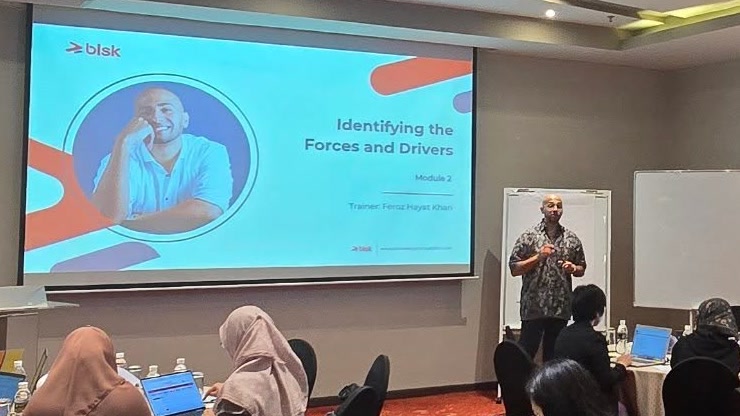
A 2-day training course for corporations and government organizations
General Information
| Details | Description |
|---|---|
| Course Date and Venue | 05-06 Nov 2024 JW Marriott Hotel KL, The Starhill, Jln Bukit Bintang |
| Trainer | View trainer profile |
| Registration | Register online |
| Further Info | Whatsapp Admin |
| Course Fees | RM1,799 per pax; or RM1,399 per pax for groups of 3 & above Included: venue and meals for the participant (2 tea breaks and 1 lunch for 2 days) |
Course Summary
Scenario planning prepares organisations to make robust choices in an uncertain environment. It broadens strategic attention beyond a single expected future and turns alternative possibilities into questions for action today.
Over two days, participants work through a structured approach: identifying the forces and drivers that create uncertainties, selecting the most critical ones, mapping them on a 2×2 scenario matrix, analysing what each scenario means for the organisation, and continuously reviewing strategies and action plans.
Course Objectives
- Understand the core concepts, purpose, attributes and misconceptions of scenario planning, and apply a structured approach.
- Identify forces, drivers and possible uncertainties affecting businesses and government organizations using PESTLE and cross-functional analysis.
- Select and prioritise the most critical drivers and uncertainties by applying relevance, importance, impact and volatility criteria.
- Develop a 2×2 Scenario Matrix by mapping two critical uncertainties on the X and Y axes and constructing four plausible future scenarios.
- Analyse the opportunities and challenges within each scenario, develop actionable Scenario Action Plans using customizable templates, and continuously review the scenarios and strategies.
Who Should Attend
Executives, managers and senior managers from all management fields, both technical and non-technical, in corporations and government organizations who contribute to strategic planning, business or public-service improvement, risk-informed decisions and organisational preparedness.
Course Module Outline
Module 1: Introduction to Scenario Planning
- Understanding the purpose and core concepts of scenario planning
- Why scenario planning matters for businesses and government organizations
- Common misunderstandings and misconceptions about scenario planning
- Understanding the distinction between scenario planning, forecasting and risk planning
- Introduction to a structured approach to scenario planning
Module 2: Identifying the Forces and Drivers that Create Uncertainties
- Understanding forces, drivers and uncertainties
- Identifying internal and external forces using PESTLE and other relevant perspectives
- Identifying change drivers and describing the uncertainties they could create
- Gathering input from departments and relevant stakeholders
- Practical application using the Scenario Planning Mapping Templates
Module 3: Selecting the Most Critical Uncertainties
- Selecting critical drivers based on relevance and importance
- Selecting critical uncertainties based on impact and volatility
- Reaching group consensus on the critical uncertainties
- Prioritising and documenting selections using Simple and Advanced Mapping Templates
- Practical application: shortlisting uncertainties for scenario development
Module 4: Mapping the Two Most Critical Uncertainties on a 2×2 Scenario Matrix
- Understanding the structure and purpose of the 2×2 Scenario Matrix
- Mapping two critical uncertainties on the X and Y axes
- Developing, naming and describing four plausible future scenarios
- Exploring the reasons for using two uncertainties and possible scenario permutations
- Practical application: constructing and interpreting a Scenario Matrix
Module 5: Scenario Strategy and Continuous Review
- Analysing positive and negative implications of each scenario
- Developing Maximisation and Minimisation Strategies
- Translating strategic responses into clear and actionable Scenario Action Plans
- Using the Simple, Detailed and Advanced Scenario Planning Action Plans Templates
- Applying complementary implementation approaches where appropriate, including PDCA and OODA
- Continuously reviewing future signals, assumptions, action plans and strategies
Any inquiries?
Email to: info@blankskriptconsultants.com